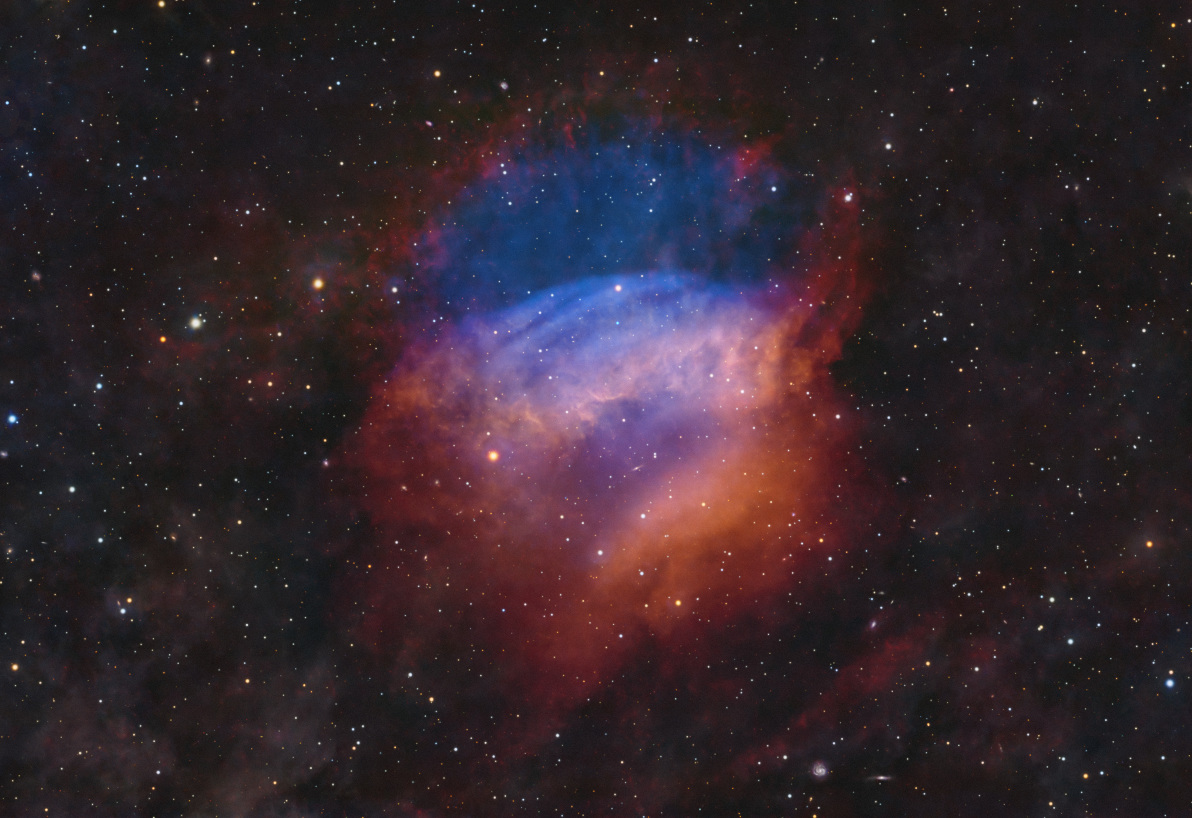
Valentine Rose - Sh2-174, PN G120.3+18.3
Valentine Rose - Sh2-174, PN G120.3+18.3
|
|
MOUSE-OVER
IMAGE FOR STARLESS VIEW CLICK
ON IMAGE FOR FULL SIZE VIEW (7198x4940) Scope:
Celestron 9.25 Edge HD 235 mm at f/7; Camera: ASI294MM (Baader
LRGB, Ha, OIII Filters) Acquisition:
DAA Observatory, Shelter Valley, CA;
/ August 26, September 15, 23, 2025 Ha
- 102 x 5 minutes (gain-180, 2x2), OIII - 102
x 5 minutes (gain-180, 2x2), Lum 72 x 3 minutes (gain-121 2x2), RGB -
32 each x 2 minutes -
(gain-121 2x2) Total - 23.8 Hrs
Processing: Data Collection - N.I.N.A. (as FITs).
Sub-frame calibration - Pixinsight (WBPP). Sub-frame registration and
integration (Average combine - Linear fit clipping, 2X drizzle
for Lum, OIII, and Ha) - PixInsight (WBPP). Noise reduction - NoiseXTerminator
(RGB, Lum, OIII, Ha) - PixInsight. Non-linear stretching for Lum, OIII, Ha
-
PixInsight. RGB combine and stretching, Photometric RGB calibration (SPCC)
- PixInsight. De-convolution - BlurXTerminator (AI4) - PixInsight.
Generation of starless Lum, OIII, Ha, and RGB images for later processing
-
StarXTerminator (PixInsight). Lum starless combined to RGB
starless; OIII and Ha (HOO Palette) starless screened to LRGB starless - Pixinsight. Lum stars combined to RGB stars - Pixinsight. LRGB stars screened onto
HOO / LRGB starless images - Pixinsight. Final finishing - Affinity Photo.
Annotation - PixInsight, Aladin (Simbad), and Affinity Photo. This image is an HOO
/ LRGB image. Image processed at 8,288x5644 resolution (2x drizzle). Full Field combined image size is approximately
7198x4940.
Description: North to the left in this image. The planetary nebula, Sh2-174
(co-identifiers PN G120.3+18.3, LBN 598) is also called the Valentine Rose. It
is the predominant center object. Its
distance is approximately 980 light years. The planetary nebula's
'Progenitor" star (White Dwarf) is GD 561. For most planetary nebulae, the
progenitor star is mainly central to the nebula (also called its central star).
For Sh2-174 the progenitor (GD 561) is significantly offset from the planetary
center. This
asymmetry is caused by the interaction of the Planetary moving through
the surrounding Interstellar Material (ISM). This movement forms a bow
shock from the star GD 561. As planetary and progenitor star enters
further into the ISM, the bow shock is disrupted; the planetary shell
material is stripped from the leading edge and is deposited downstream.
The upstream portion of the PN is slowed relative
to GD 561 - thus leaving the star well offset from the Planetary
center. GD 561 is the little blue star seen between the top edge of
the bright blue arc and the brightest part of the red Ha (the upper
center of the image - see it identified in the annotated
image. This
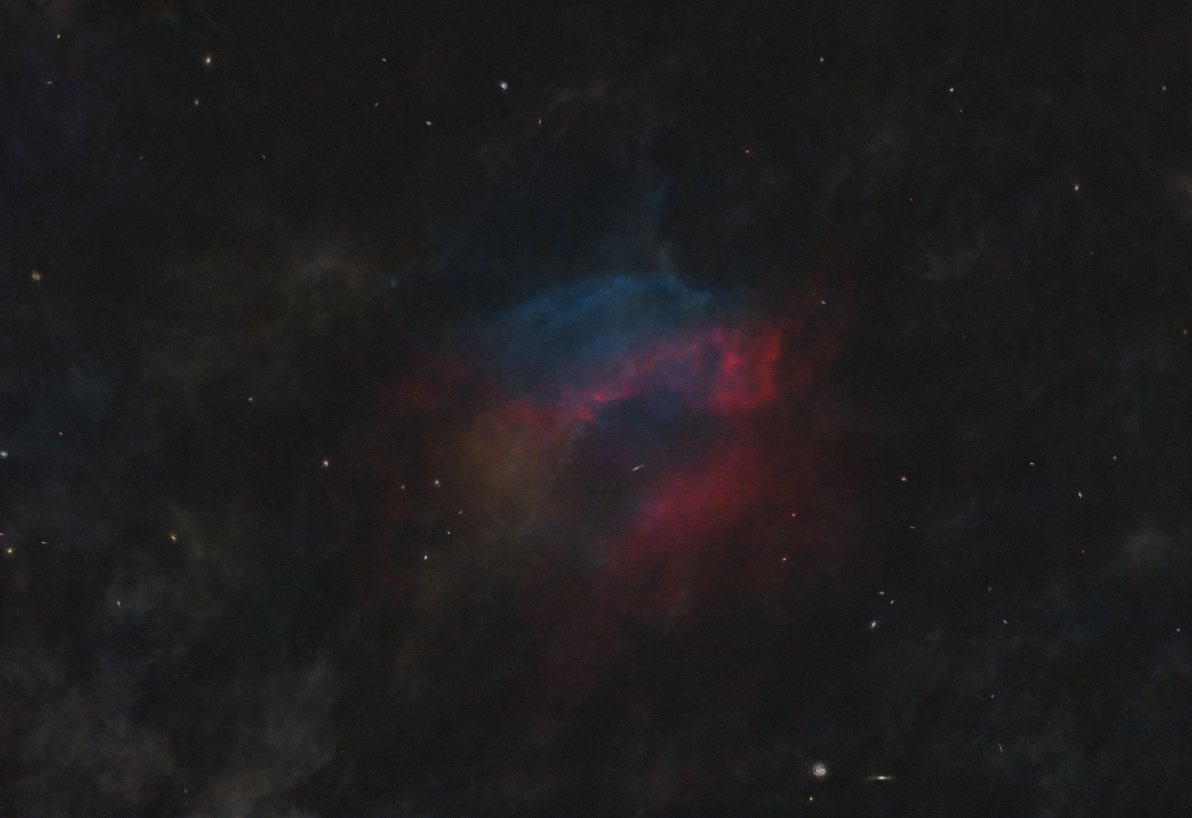
image captures both the broad band structure of the ISM (seen as the
dim, brown dusty areas) as well as the narrow band (Ha/OIII) bright, red/blue
emission structure of the PN and ionized ISM of Sh2-174 by GD 561. The
image below shows the broad band / narrow band mouse-over comparison
between these two structures. Mouse-over toggles the comparison (with
some color bleed from narrow band onto the broad band image).
These objects,
information, background galaxies, and some of the brighter stars are identified in the
annotated
image.
The Horizontal Full FOV is approximately 0.656 degrees. Full
size, full field image scale is approximately 0.328 arcsec/pix.
Image
center approximately - Equatorial 2000: RA: 23h 46m 15s Dec: +80°57'28" STARLESS
BROAD BAND AND NARROW BAND COMPARISON
|
All images and content remain the property of Jim Thommes - copyright 2003 - 2026 Current
Web Total Hits -
- Unique Visitors |